Search consultant website templates and you get thousands of pretty themes. Almost none of them tell you the thing that actually matters: a consultant’s website has one job, turn a visitor into a booked call. This guide covers the best template options in 2026 by consultant type, the seven things a template needs to convert, and the honest case for when a done-for-you build beats a template entirely.
Whether you are an independent consultant, a coach, or a Fractional Executive going out on your own, the goal is the same: look established from day one.
Quick Answer
The best consultant website template is one built around a single clear offer, with a strong headline, proof, and one obvious call to action, not the one with the most pages. For most consultants and Fractional Executives, a focused one-page or five-page template converts better than a large multi-page theme.
Why most consultants pick the wrong template
The common mistake is choosing a template by looks instead of by conversion. A consultant or Fractional Executive is not a twenty-page business. You sell expertise and trust, and a template stuffed with a blog, a shop, a portfolio grid, and a dozen service pages spreads a visitor’s attention thin.
The pages that actually book calls are simple: a positioning-led home page, a clear “how I help” or engagements page, proof, and a contact or scheduler. Everything else is noise. As Harvard Business Review has long argued about positioning, clarity beats breadth. Your template should force that clarity, not fight it.
Key takeaway: Big, feature-heavy themes look impressive but bury the offer. A consultant site has one job: book the call.
What a high-converting consultant template actually needs
Before you fall for a design, check it against this list. A strong consultant website template gives you:
- A problem-first headline that names the client’s pain in their words, not your job title.
- A packaged offer: named engagements with outcomes, not an hourly rate buried on a pricing page.
- Proof up high: precise numbers, recognizable logos, and a testimonial near the top of the page.
- One primary call to action (“book a call”) repeated down the page, not five competing buttons.
- A built-in scheduler so an interested visitor books instantly instead of hitting a contact-form dead end.
- Fast, mobile-first design, because most prospects check you on a phone right after the intro call.
- SEO basics: a proper title, meta description, one H1, and schema, so you are findable at all.
If a template is missing more than one or two of these, you will spend your first free weekend rebuilding it anyway.

Key takeaway: Seven elements separate a template that books calls from a pretty brochure.
The best consultant website templates by type
There is no single best template, only the best fit for your offer. Here is how the main types break down:
- Business consultant website template. Clean, corporate, and proof-heavy. Good for advisory and operations consultants who sell credibility and process. Lead with logos and results.
- Marketing consultant website. Bold and results-forward, driven by case studies. This is the right lane for a Fractional CMO whose value is measured in pipeline and revenue.
- IT or technical consultant website template. Structured and credibility-first, with a clear services and stack section. Fits Fractional CTOs and independent IT consultants.
- Independent or solo consultant template. A one-page, offer-focused layout that is the fastest to launch and, for most people going solo, the highest converting. This doubles as your personal brand website.
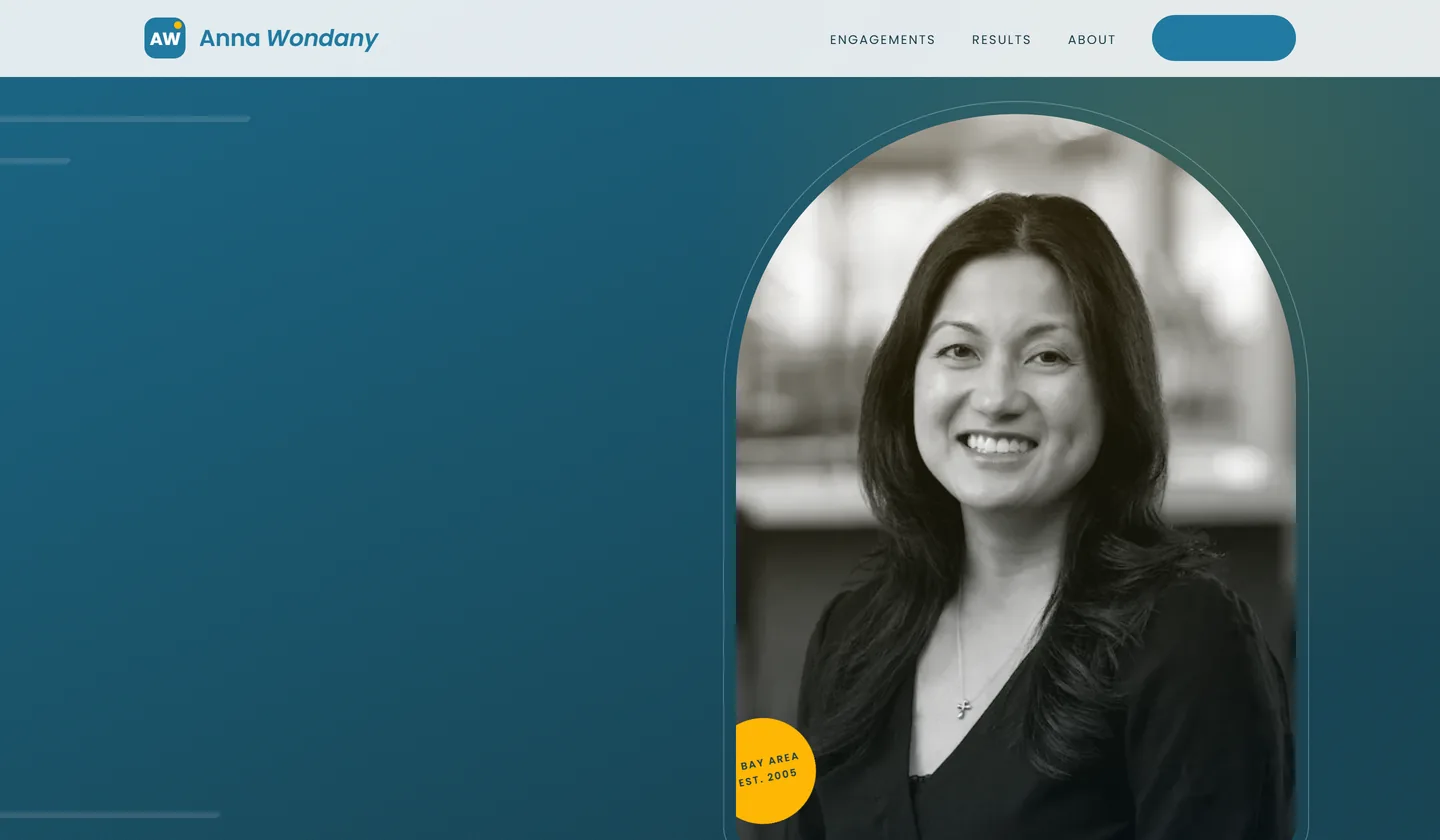
The screenshot above is a positioned Fractional CMO site, notice how little it asks the visitor to do. One message, one offer, one button. You can see more real fractional and consultant website examples to calibrate what “done right” looks like.
Key takeaway: Match the template to your niche. Here is where each type of consultant should start.
Template vs done-for-you: the honest trade-off
A template is the right call if you have time, some design sense, and a clear message already written. It falls short in three specific situations: you do not yet know what to say (positioning), you cannot spare a weekend wrestling with a page builder, or you need the site live before a pitch next week.
That gap is exactly what a done-for-you website closes. Instead of buying a blank template and staring at it, you get the copy, design, and build handled for you, positioned around your offer, and launched in a week at a fixed price. According to Forbes Agency Council contributors, the biggest driver of a professional-services site’s performance is message clarity, not visual polish, and message is precisely what a raw template leaves up to you.
Key takeaway: A template saves money. A done-for-you build saves the thing consultants have least of, time, and gets the positioning right.
How to launch fast, either way
Follow this order and you will not stall:
- Nail the offer and headline before you touch design.
- Write the proof section next, with real numbers.
- Keep it to five pages maximum. More pages dilute the single goal.
- Connect a scheduler so calls book themselves.
- Ship it, then improve. A live imperfect site beats a perfect draft.
If you are still deciding whether to go independent at all, start with our guide on how to become a Fractional Executive, then come back and build the site that makes it real.
Key takeaway: Whether you DIY or hand it off, the order is the same: message first, design second.
Which route fits you?
DIY template
Cheapest and fully in your control. Best if you have time, design sense, and your message already written. Expect a weekend of work.
Hire a freelancer
More custom, but you still supply the copy and positioning, and timelines and quality vary widely. Mid-range cost.
Done-for-you
Copy, design, and build handled and launched in a week, positioned around your offer. Fixed price, fastest path to booking calls.
Frequently Asked Questions
How much does a consultant website template cost?
Do I need coding skills to use a consultant website template?
How long does it take to launch a consultant website?
One page or multi-page for a consultant site?
What is the best template for a Fractional CMO, CTO, or CFO?
Skip the template hunt
Get a positioned, professionally designed consultant website, written, designed, and launched for you in a week. Fixed price, no DIY headache.