

Monthly Retainer Model
The most common Fractional CMO pricing model is the monthly retainer. This model is built around ongoing leadership engagement rather than transactional delivery. Instead of tracking hours or sessions, the agreement defines a consistent monthly scope that includes strategic leadership, decision support, and marketing oversight. In practice, this means the Fractional CMO is integrated into the company’s operating rhythm. They participate in leadership discussions, guide prioritization, and stay close to execution without being a full-time hire. The key advantage of this model is continuity. Because the fractional leader remains embedded in the business over time, they gain context that improves decision quality and strategic consistency.Project-Based Pricing Model
Project-based pricing is another core structure within the Fractional CMO pricing model. This model is best used when the scope is clearly defined and time-bound. It applies to situations in which a company needs focused expertise to solve a specific marketing challenge or to complete a defined initiative. Typical use cases include brand repositioning, go-to-market planning, marketing system redesign, or funnel optimization. For Fractional leaders, the critical success factor in this model is clarity. The scope must be tightly defined, with clear boundaries around deliverables and responsibilities. Without that structure, project work can easily expand beyond its original intent. When executed well, project engagements often demonstrate value quickly and can naturally evolve into longer-term leadership relationships. For structured examples of how to scope, package, and position project-based engagements, the Hey CMO Fractional Playbooks provide practical frameworks, including templates for defining deliverables, setting boundaries, and pricing with confidence.Hybrid Model with Performance Alignment
The hybrid model combines a base retainer with performance-based incentives. In this structure, the Fractional CMO receives a consistent monthly fee for leadership and execution support, along with additional compensation tied to agreed performance metrics. This model is often used in high-growth environments where both parties want alignment on outcomes such as pipeline growth, revenue contribution, or customer acquisition efficiency. However, Fractional leaders need to be precise about attribution. Marketing outcomes are influenced by multiple variables, including product quality, sales execution, pricing strategy, and market conditions. A well-structured hybrid model clearly separates what the Fractional CMO can directly influence from what sits outside their control. Without this clarity, performance-based structures can create misaligned expectations.
 The advisory model represents the lightest form of Fractional CMO engagement and is used only in specific, constrained scenarios.
It is best suited for targeted executive input, decision validation, or short-term strategic guidance where ongoing embedded leadership is not required.
In this format, the Fractional CMO acts as a senior advisor rather than an integrated operator within the business. As a result, the depth of context is naturally limited compared to retainer-based engagements.
Because Fractional leadership is most effective when it is continuous and embedded, advisory work is typically treated as a supplementary layer rather than a core engagement model.
Most experienced Fractional CMOs do not structure their primary offerings around advisory or hourly arrangements, since these formats reduce strategic continuity and limit influence over execution.
The key limitation of this model is not flexibility, but depth. Without sustained involvement in the business, the ability to shape decisions and drive long-term outcomes is significantly reduced.
The advisory model represents the lightest form of Fractional CMO engagement and is used only in specific, constrained scenarios.
It is best suited for targeted executive input, decision validation, or short-term strategic guidance where ongoing embedded leadership is not required.
In this format, the Fractional CMO acts as a senior advisor rather than an integrated operator within the business. As a result, the depth of context is naturally limited compared to retainer-based engagements.
Because Fractional leadership is most effective when it is continuous and embedded, advisory work is typically treated as a supplementary layer rather than a core engagement model.
Most experienced Fractional CMOs do not structure their primary offerings around advisory or hourly arrangements, since these formats reduce strategic continuity and limit influence over execution.
The key limitation of this model is not flexibility, but depth. Without sustained involvement in the business, the ability to shape decisions and drive long-term outcomes is significantly reduced. 
The most important shift in mindset is understanding that pricing is not about hours or availability. It is about leadership leverage.
Strong Fractional CMOs position themselves as embedded executives who operate inside decision-making systems. They are not external observers or task-based consultants.
This positioning directly influences how the Fractional CMO pricing model is structured, negotiated, and sustained over time.
When Fractional leaders operate from a leadership-first mindset, pricing naturally reflects strategic responsibility rather than time allocation.
 To see how fractional vs full-time executive costs compare in practice, you can explore the Hey CMO AI Fractional Executive Cost Calculator
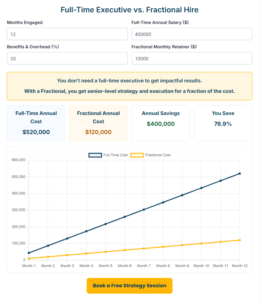 To see how fractional vs full-time executive costs compare in practice, you can explore the Hey CMO AI Fractional Executive Cost Calculator